Bukowina Tatrzańska: thermal pools, mountains and trip ideas
BUKOVINA thermal baths, the Tatra panorama from Głodówka, Morskie Oko and Rusinowa Polana, highlander events all year. Plans for one day and longer, trails, getting there and answers to common questions.
Best time to visit
All year round: skiing and thermal baths in winter, the Tatras and folk festivals in summer. Quietest in June and September.
How many days
2–3 days for the thermal baths and one Tatra trip; a week to add Morskie Oko lake and Slovakia.
Getting there
Direct buses from Kraków; from Zakopane, local municipal lines via Poronin. By car via Nowy Targ.
Without a car
The centre and the thermal baths are walkable; in summer the municipal bus no. 10 runs to Palenica Białczańska in the morning.
Who it suits
Families with children, skiers, hikers and fans of highlander (Górale) and Spiš folklore.
Videos
Videos from our trips
Short clips from the @tatryrazem TikTok account. The TikTok player only loads when you click.
Young highlanders performing at the Dom Ludowy cultural centre in Bukowina Tatrzańska
A Tatra panorama, a highlander village and an evening in thermal water.
Morning: Polana Głodówka or Rusiński Wierch — the view of the Tatras is clearest before noon.
Late morning: the old church, the new church and the wooden Dom Ludowy (Folk House) in the village centre.
Afternoon: Termy Bukovina — a few minutes’ walk from the centre.
Evening: dinner at a karczma (inn) serving Podhale cuisine.
02
Weekend (2–3 days)
One Tatra trip, one day of culture and room to spare for the weather.
Day 1: the “Bukowina in one day” plan.
Day 2: Morskie Oko from Palenica Białczańska (parking only with an online booking) or, at a gentler pace, Rusinowa Polana from Wierch Poroniec.
Day 3: Jurgów — the wooden church and the Sołtys family farmstead — then in the afternoon Terma Bania in Białka or, if it rains, the Belianska jaskyňa cave in Slovakia.
03
With kids and for rainy days
A programme that is easy to move indoors.
Thermal baths: year-round water slides at Bukovina; a paddling pool for toddlers and a water playground at Bania.
Farmstead museums in Jurgów and Czarna Góra — short visits with plenty to look at up close.
When it clears up: Rusinowa Polana from Wierch Poroniec, or the chairlift and playground on Kotelnica in summer.
Thermal baths and family attractions
Thermal baths and family attractions
The thermal water is right in the village centre, with more complexes in Białka and Chochołów.
Termy Bukovina
20 indoor and outdoor pools with thermal water at 30–38°C, drawn from a depth of 2400 m beneath Wysoki Wierch. Plus 8 saunas, year-round water slides and two summer ones.
3–4 h
all year, daily 9:00–22:00
Paid ticket
With children
Rainy day
Every autumn there is a maintenance break: in 2026 the children’s zone is closed 28 September – 2 October and the saunas 26–30 October. Check the announcement before you go.
15 pools and 2400 m² of water surface in three separate zones: fun, relaxation and saunas. In the fun zone the water is 34–38°C, and the slides total more than 300 m.
half a day
all year, daily 9:00–22:00
Paid ticket
With children
Rainy day
For the youngest there is a paddling pool up to 35 cm deep and an indoor water playground.
The largest complex in the area: 52 pools and about 4500 m² of water surface at 32–38°C. Further away than Bukowina and Białka, but a good choice for a whole rainy day.
half a day
all year
Paid ticket
With children
Rainy day
The baths are closed from 19 to 30 October 2026 for modernisation.
Outside the ski season the chairlift takes you up to the summit, with a view of the Tatras. At the top: the “Wioska Skrzatów” (Gnome Village) playground, off-road scooters and a bike park for cyclists.
2–3 h
summer
Paid ticket
With children
The lift’s opening hours depend on the weather and the season — check them on the resort’s website.
A ridge above Bukowina with the Rusiń-Ski ski station. It offers views of the Tatras, the Gorce range and Babia Góra; at the top there is a karczma (inn) by the lift station.
1–3 h
all year
Free
With children
A blue walking trail leads up from the centre (see “Trails nearby”).
Formerly known as Wierchowa: a scenic ridge road between Leśnica and Białka, over Koszarków Wierch to Kobylarzówka. Legend links it to King Jan Kazimierz’s escape from the Swedes.
A walk to two chapels: Brzeziński’s Chapel from 1922, with an original painting of the Holy Trinity by the painter Jan Brzeziński, and the Patriotic Chapel, where ceremonies were held between the wars.
From Bukowina, Palenica Białczańska and the border crossing at Łysa Polana are closest. There is an entry fee for TPN (Tatra National Park), and dogs are not allowed.
Morskie Oko
The most famous lake in the Polish Tatras, with views of Rysy among other peaks. A tarmac road leads from Palenica Białczańska, passing Wodogrzmoty Mickiewicza (Mickiewicz Waterfalls) on the way. A loop of about 2.5 km runs around the lake.
full day
all year; avalanche risk in winter
Book online
Parking at Palenica only with a ticket bought online — if there are no spaces online, there will be none on site either. It is a few degrees colder by the lake.
A valley with five lakes and the highest mountain hut in the Polish Tatras (1671 m). From Palenica through the Roztoka Valley, past Wielka Siklawa, a waterfall over 70 m high.
full day
late spring to autumn
Paid ticket
The loop over the Świstówka pass to Morskie Oko is about 20 km — only for fit hikers, in settled weather.
A vast glade (approx. 1200 m) with one of the finest panoramas of the High Tatras and traditional sheep grazing kept up as cultural heritage. Just below is the Marian sanctuary at Wiktorówki, linked to the legend of a shepherdess from around 1860.
3–4 h
all year
Paid ticket
With children
The gentlest approach is from Wierch Poroniec; from Zazadnia the route leads via Wiktorówki.
A summit (1489 m) with dolomite rocks above Rusinowa Polana. The climb is short but steep — more than a thousand wooden steps. From the top there is a wide panorama of the Tatras.
A dripstone cave in Tatranská Kotlina, beyond Ždiar. The route is 1370 m long with 874 steps, the tour takes about 70 minutes, and it is 5–6°C inside.
half a day
opening days in the cave’s calendar
Paid ticket
With children
Rainy day
From the car park to the entrance is an uphill walk of about 25 minutes. Tours start at fixed times and tickets cannot be booked — bring a warm jumper.
From Tatranská Lomnica, cable cars go up to Skalnaté pleso, Lomnické sedlo and all the way to Lomnický štít (2634 m) — one of the highest peaks in the Tatras.
half a day
all year, weather permitting
Paid ticket
The ride to Lomnický štít depends on the weather and ticket availability — check online before you set off.
The municipality spans Podhale and Polish Spiš. You will see the most in Bukowina, Białka, Jurgów and Czarna Góra.
Dom Ludowy (Folk House) in Bukowina
One of the largest wooden buildings in the area; its theatre hall has been in use since 1932. Today it is the Bukowina Culture Centre — organiser of the Góralski Karnawał and Sabałowe Bajania.
1–2 h
all year
Rainy day
Check the calendar before you come: plays in the local dialect, folk band competitions and concerts take place all year round.
A masonry church with a wooden tower from 1887, built through the efforts of the villagers. The wall paintings were made in 1937 by Paweł Pełka; it has been a listed monument since 1994.
15 min
Outside only
Services are held here only occasionally — it is usually seen from the outside.
A church of reinforced concrete, marble and glass (1974–1982) designed by Wojciech Pietrzyk — a highly regarded example of modern sacred architecture. The main altar was made by local highlanders.
The wooden Church of St Simon and St Jude Thaddeus from the first half of the 18th century, consecrated in 1765 and surrounded by old lime trees. Inside: a Rococo-Neoclassical main altar from 1780 and Baroque sculptures.
The Church of St Sebastian from around 1675, entirely clad in wooden shingles. The interior is decorated with Rococo wall paintings from 1813. It lies on the Wooden Architecture Route.
20 min
Free
On Sundays a Mass in Slovak is also celebrated here.
Zagroda Sołtysów in Jurgów (Sołtys family farmstead)
A Spiš farmstead from 1861, a branch of the Tatra Museum (Muzeum Tatrzańskie): house and farm buildings under one roof, costumes, tools and a weaving workshop.
45 min
all year
Paid ticket
With children
Rainy day
Closed on Wednesdays in summer, and on Mondays and Tuesdays out of season. Admission is free on Thursdays.
Zagroda Korkoszów in Czarna Góra (Korkosz family farmstead)
A prosperous Spiš farm from the turn of the 20th century, extended with stone buildings in the 1930s. Inside: a kitchen, living rooms and a carpentry workshop.
45 min
all year
Paid ticket
Rainy day
Closed on Tuesdays in summer, and on Mondays and Tuesdays out of season.
The municipality has many ski areas — from large resorts in Białka to short lifts in the centre of Bukowina.
Rusiń-Ski
A family ski station on Rusiński Wierch: a six-seater and a four-seater chairlift, two T-bar lifts and a magic carpet for children. The runs are blue, the longest is 1200 m, and the wide slopes are good for learning.
full day
winter
Paid ticket
With children
The beginners’ lift is separated from the main run. The slope has snowmaking and floodlights.
The largest ski resort in Podhale: well over ten kilometres of runs of varying difficulty, a snow park and family zones. The runs have snowmaking and floodlights.
full day
winter
Paid ticket
With children
Between Kotelnica and Jankulakowski Wierch there are free, floodlit cross-country trails — four loops from 1.25 to 4.4 km. Free ski buses run in Białka in winter.
Short, gentle slopes for learning and for a quick session without driving anywhere, including the “Przy Kolibie” and “Ku Dolinie” lifts and the slopes on Wysoki Wierch.
2–3 h
winter
Paid ticket
With children
Good for a first day on skis or an evening session — check locally which lifts are running.
A ski station on Górkowy Wierch above Jurgów: 9 runs totalling 4.5 km, including a black and a red — among the more difficult in Podhale. A karczma (inn) with a view at the top.
One ski pass for 19 resorts in Poland and Slovakia, including Rusiń-Ski, Kotelnica, Kaniówka, Jurgów Ski and Kasprowy Wierch. Worth it if you ski for several days in different places.
winter
Paid ticket
Reduced passes are available for children under 16 and seniors aged 65 and over.
Data from the TPN trail cards; for walking paths outside the park and sections without a TPN card, from mapa-turystyczna.pl. Times are one way without breaks, unless a loop is described.
Trail
Distance
Time
Ascent
Difficulty
Good to know
To Wierch Kurucowystart: Bukowina centre
4.1 km
approx. 1 h 25 min
approx. 250 m
easy
A yellow walking path outside the national park — good for a warm-up and a walk with a dog on a lead. with a dogTrail details
To Rusiński Wierchstart: Bukowina centre
6.9 km
approx. 2 h 25 min
approx. 350 m
moderate
A blue walking path to a ridge with views of the Tatras, the Gorce range and Babia Góra. Outside TPN, so dogs are welcome too. with a dogTrail details
Along the blue trail through the Filipka Valley to the sanctuary at Wiktorówki. In 2026 the Zazadnia car park was temporarily closed due to road works — check the TPN announcement. Trail details
Gęsia Szyjastart: Rusinowa Polana
1.3 km
approx. 45 min
approx. 280 m
moderate
Steeply up more than a thousand wooden steps to a 1489 m viewpoint. For the descent you can take the green trail to Rówień Waksmundzka. Trail details
Morskie Okostart: Palenica Białczańska
approx. 9 km on tarmac
approx. 2.5 h
approx. 410 m
moderate
A full-day trip; TPN gives 11.6 km including the loop around the lake. Horse-drawn carts run to Włosienica, and TPN e-buses with a ticket bought online. Trail details
Valley of the Five Polish Ponds and Morskie Okostart: Palenica Białczańska
approx. 20 km (loop)
approx. 8 h
approx. 1000 m
demanding
Through the Roztoka Valley to the mountain hut (1671 m) and over the Świstówka pass to Morskie Oko. Set off at dawn; in winter the gullies are prone to avalanches. Trail details
Events
Events through the year
The most important annual events in the municipality. The 2026 dates come from the organisers; the 2027 dates have not yet been announced — later editions usually fall in the same period.
February
Góralski Karnawał (Highlander Carnival)
usually in February (2026: 5–8 February)
Competitions for carol-singing groups and the zbójnicki (highland outlaws’) dance, a parade of horse-drawn sleighs through the village, and an exhibition of folk art and Podhale sheepdogs. The programme also includes kumoterki races in traditional highlander sleighs (on Rusiński Wierch in 2026).
The Festival of Polish Folklore, held for the 60th time in 2026: competitions for storytellers, musicians, singers and wedding masters of ceremonies (drużbowie), a parade of horse-drawn carriages, tastings of regional dishes, a bonfire (watra) and concerts in front of Dom Ludowy.
A festival in the Tatrzańskie Wici series: opened with hunting horn calls, followed by a shooting contest, performances by local groups and attractions for children.
Cepr and Ceperka of the Year and Harnaś of the Year
August (2026: 8–9 August)
Two days of fun in Białka Tatrzańska in the Tatrzańskie Wici series — contests for visitors (“ceprzy”, as highlanders call lowlanders) and locals alike.
Gatherings of Podhale folk bands in the traditional three-piece line-up, honouring the tradition of the Bukowina musician Bronisława Dziadoń-Konieczna, known as Dziadońka. Intimate music-making in the wooden Dom Ludowy.
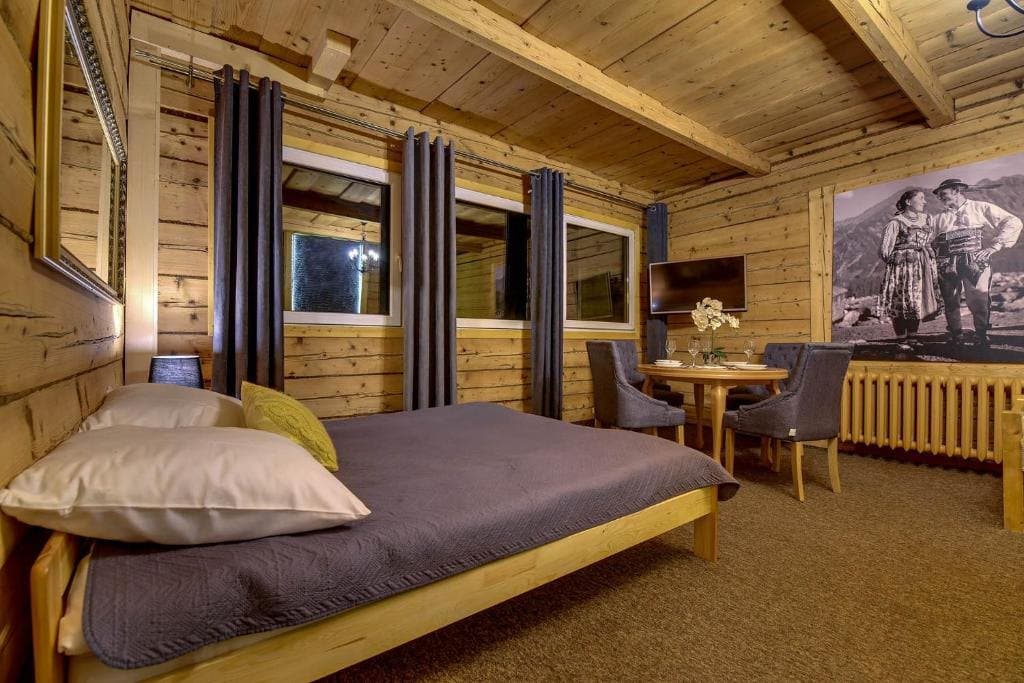
From Kraków take the Zakopianka road to Nowy Targ, then continue via Białka Tatrzańska or via Poronin. From Orla Village Bukowina in the centre of Bukowina it is approx. 30 km to Poprad-Tatry Airport and approx. 85 km to Kraków-Balice.
Buses
Direct buses run from Kraków, including Szwagropol via Nowy Targ. Municipal public service lines run from Zakopane to Bukowina, Białka and Jurgów.
From 1 July to 31 August, municipal line no. 10 runs from Bukowina to Palenica Białczańska twice a day (in 2026 from the Kościół stop at 7:02 and 9:47) and returns at 14:00 and 17:00. From Palenica to Włosienica, TPN e-buses run — only with a ticket bought online.
Entry to TPN costs 11 zł (reduced 5.50 zł); children under 7 enter free. Parking below Morskie Oko is bought online (in 2026, 36–75 zł depending on the day). In the summer holidays an alternative car park operates at the Rusiń-Ski station, served by public transport.
The centre of Bukowina has shops, a post office and a branch of Tatrzański Bank Spółdzielczy with a cash machine. In Slovakia you pay in euros.
Safety in the Tatras
TOPR (Tatra Mountain Rescue) emergency number: 985 or +48 601 100 300; 112 also works. It is worth installing the Ratunek app. From 1 March to 30 November hiking in TPN is prohibited between dusk and dawn. With a dog you may only enter the Chochołowska Valley and the Droga pod Reglami path.
The Łysa Polana crossing is in the Schengen area, but bring an ID card or passport. The Slovak mountain rescue service, Horská záchranná služba (number 18 300), may charge the rescued person for the operation, and the EHIC covers medical treatment only — take out mountain rescue insurance before heading into the Slovak mountains.
Skiing at many stations in the municipality, thermal baths after the slopes, horse-drawn sleigh rides and the Góralski Karnawał in February. School winter holidays and the Christmas and New Year period bring the biggest crowds.
Spring
Quieter than in season. Lower trails such as Rusinowa Polana open up earlier than the higher areas, where snow lingers for a long time and the gullies are prone to avalanches.
Summer
All trails open, Sabałowe Bajania and the Tatrzańskie Wici festivals, the summer slides at the thermal baths and bus no. 10 to Palenica. Book parking below Morskie Oko in advance.
Autumn
Fewer people and colourful forests. In September and October the thermal baths take maintenance breaks — check the announcements. In November it gets dark early.
FAQ
Questions and answers
Can you get from Bukowina to Morskie Oko without a car?
Yes, in summer. From 1 July to 31 August the municipal bus no. 10 runs from Bukowina to Palenica Białczańska in the morning and returns in the afternoon (two runs each way). From Palenica to Włosienica you can take a TPN e-bus with a ticket bought online, or a horse-drawn cart. Outside the summer holidays the easiest option is to drive, with a parking booking.
Which thermal baths should I choose?
Termy Bukovina are in the village centre: 20 pools, 8 saunas and new water slides. Terma Bania in Białka has separate fun and relaxation zones and a paddling pool for toddlers. Chochołowskie Termy are the largest but the furthest away — good for a whole rainy day. In autumn, check for maintenance breaks.
What to do in Bukowina when it rains?
The thermal baths in Bukowina, Białka or Chochołów, the farmstead museums in Jurgów and Czarna Góra, a play or concert at Dom Ludowy, and the Belianska jaskyňa cave in Slovakia, where it is 5–6°C all year round.
Is Bukowina good for families with young children?
Yes. There are thermal baths with paddling pools and water slides, gentle slopes for learning to ski, easy walks such as Rusinowa Polana from Wierch Poroniec, and a playground on Kotelnica in summer. At Orla Village Bukowina children have a play corner in the dining hall and, in summer, a playground with a trampoline.
Do I need to book parking at Palenica Białczańska?
Yes. Tickets for the TPN car parks below Morskie Oko are bought online on the park’s website. If there are no spaces online, there are none on site either. In the summer holidays you can leave your car at the alternative car park at the Rusiń-Ski station and continue by public transport.
Where can I walk with a dog in the area?
Dogs are not allowed on Tatra National Park trails, including Rusinowa Polana and Morskie Oko. You can, however, enjoy quiet walks on the paths around Bukowina, for example to Wierch Kurucowy or Rusiński Wierch. In the Polish Tatras dogs are allowed only in the Chochołowska Valley and on the Droga pod Reglami path, on a lead.